A Modern Tree House
Inspired by Squam Lake’s history, forest and light, this Passive House reinterprets the classic kids’ outdoor play platform through a contemporary, carbon-conscious lens.

Prioritizing the health of the hemlock forests, Alchemy Architects built a dreamy lake house in a class by itself.
There’s a reason they shot ‘On Golden Pond’ on Squam Lake,” says Geoffrey Warner, founder and architect at Saint Paul, Minn.-based Alchemy Architects. “You’ve got the mixed pine forest, the lake, and the history of lumber and white pines and hemlocks.”

Hydraulic doors open up the living room to the lake, while a sliding door opens to connect the dining area to the porch.
When Warner’s former clients from a home in Pennsylvania relocated to Boston and found a dreamy property in Holderness, an early 20th-century cottage only 15 feet from the water’s edge, they enlisted Warner’s team with a clear remit: to maintain the modest footprint by the water, outfit the cottage for year-round living, and build a sustainable home respectful of the surrounding mature forest, all within a modernist vocabulary.
“This part of Squam Lake is close to national forest land,” Warner says. “Whenever you build on a site like that, I think you have to, as the Boy Scouts would say, leave the land better than how you found it, which is obviously difficult when you’re building anything new.”
Alchemy specializes in residential architecture, often renovating craftsman bungalows typical of the Twin Cities, and in 2003 they developed the weeHouse, a modern modular program that uses pre-fabrication to embrace small, efficient, sustainable dwellings.
If you slam a platonic box into a forest, you’re going to get these places where the trees poke through the facade, walls and ceiling.
Drawing upon Alchemy’s expertise and the imperative to “leave no trace” in Holderness, they developed a pre-fabricated Passive House that blends with the surrounding hemlock forest. Warner’s team designed the house’s interior almost entirely with white oak over an engineered soft wood core for the floor, walls and ceiling to make the build stabler and more sustainable than solid wood. To reduce the Tree House’s envelope, a partial timber frame was panelized off-site by Walpole-based Bensonwood, using fiber-based, dense-packed insulation and exterior sheathing made from hydrophobic compressed wood fiber.

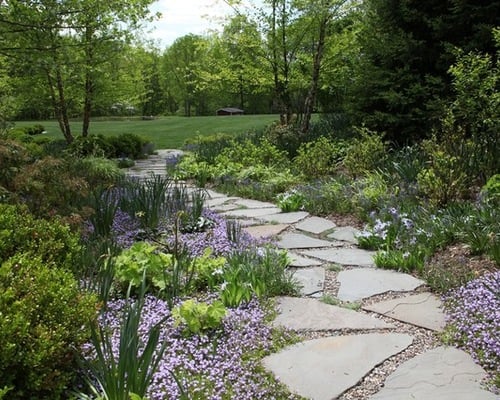
Thoughtful landscaping enhances the home-owners’ experience of the property. Only steps from Squam Lake, they’re ready to unwind.
In conceiving of the Tree House, they imagined a “box of trees” dropped onto the forest floor, creating an opportunity for functional and thematic play.
“If you slam a platonic box into a forest, you’re going to get these places where the trees poke through the facade, walls and ceiling,” Warner says.
Oval windows and skylights are meant to embody trees from the forest bursting through the home. Partnering with Digifabshop, they designed parametric trees that embed in the home’s architecture and filter light from the forest canopy. The staircase evokes a tree trunk lying down, making a trip upstairs a voyage into the woods. Lying around indoors, the homeowners could enjoy a forest bath.
Passing through the home’s interior, it’s clear that Alchemy realized their vision—it does feel like living inside a treehouse. Within a footprint of only 1,500 square feet, the three bedrooms can sleep up to 8 to 10 people, with more in the boathouse.

Digifabshop was a match for Alchemy’s boundless creativity, and the digital fabrication firm constructed stairs like a fallen trunk suffused with warm light. -PHOTO BY CHERYL WATSON
Digifabshop was a match for Alchemy’s boundless creativity, and the digital fabrication firm constructed stairs like a fallen trunk suffused with warm light. -PHOTO BY CHERYL WATSON
By blending the house into the surrounding environment, the space it occupies begins to feel larger without intruding upon the landscape. A handy hydraulic overhead door opens the living room up to the lake’s edge, and the live-edge dining table is ready to roll through the zero-threshold lift-slide door onto the porch. Window seats provide both seamless storage and a place for a quick nap. Surrounding blueberry-sod rain gardens manage runoff and bring greenery just a few steps away from the home’s patios.
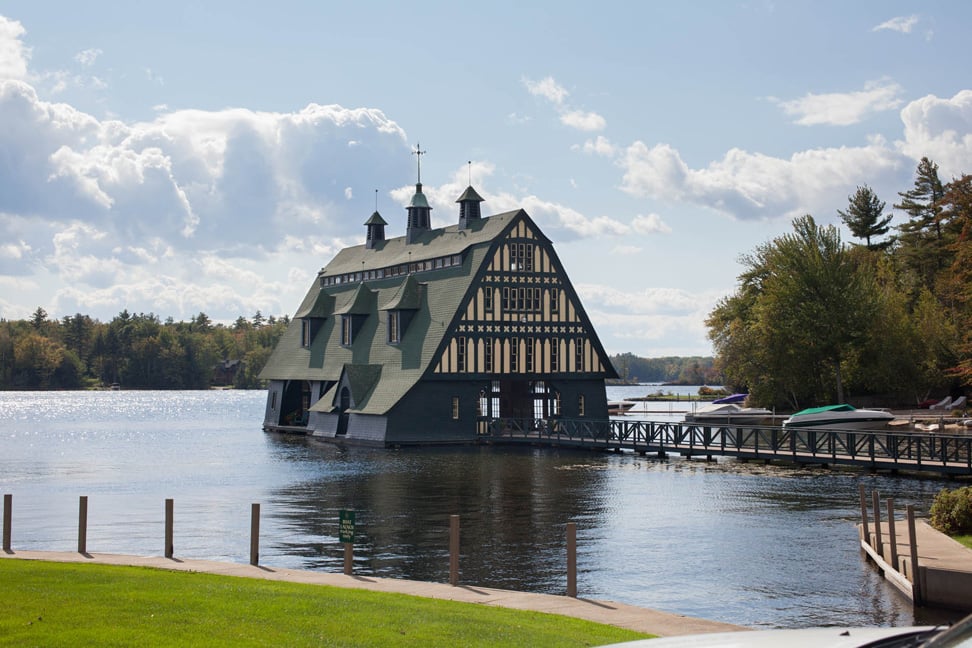
The neighboring, 600-square-foot boathouse is a sort of Quonset hut that is “somewhere between a birchbark canoe, a fallen tree and a big old sand worm,” Warner says with a laugh. The family can store kayaks and paddleboards inside, and it also features a small sleeping porch.
They built the home responsibly, too. Working within the constraints of the Passive House, they had to meet extremely precise specifications for thermal, air, radiation and moisture control.
They were not concerned about gross square footage and instead wanted to really look at the experiential qualities of being on the site.
“We don’t do it because it’s easier,” says Warner, “but if you’re going to build something new with technology that’s 150 years old, that doesn’t make much sense.

With doors opening right over the pond, the guest house isn’t too shabby a place to spend the night.
“We have the ability to make something that requires very little energy input and is made with much lower carbon content,” he adds. “That looks toward our future. What gets me excited about it is that we’re doing something that empowers people to be part of future solutions through our built environment.”
The homeowners were deeply committed to this vision as well. While many may seek to maximize square footage on their parcel of waterfront land, the homeowners had different priorities.
“They were not concerned about gross square footage and instead wanted to really look at the experiential qualities of being on the site,” Warner says.
Building more modestly within the landscape brings every room in the home closer to the outdoor environment the family so deeply loves.
“Instead of having the big lake view, how else can you get a feeling for being in the forest and somehow escape your normal life in a way that’s actually meaningful?” poses Warner.
“They are really interested in the health of the hemlock forest,” he adds. “Being in the hemlock forest and doing things that protect it for future generations — I think they feel that the house reflects that spirit.”