Passion Project
Stone sculptor Joseph Gray found his calling by listening to the material.

Carved from a layered piece of Goshen stone, a hawk leaping off the sacred Native American Mount Denali is a tribute to family and nature.
Joseph Gray did not set out to become an artist. In fact, for much of his early life no one — including Gray himself — would have described him as artistic at all. Today, Gray’s sculptures live around the world: an eagle on a cliff in St. Kitts; stonework and gardens in London; a six-month project on the French Riviera in St-Jean-Cap-Ferrat, where he learned precision limestone techniques from a master British mason.

Sculptor Joseph Gray at work on a bobcat, the mascot of Brewster Academy in Wolfeboro, where it will be on public display. Carved from NH granite, the piece and its stone base will weigh close to 4,000 pounds.
Raised in New Hampshire, Gray graduated from Plymouth State College in 1980 with a degree in accounting, a practical choice encouraged by strong math scores and sensible advice. He slogged through four years of coursework, dutiful and uncertain. “I wouldn’t say I was thrilled with the idea of being an accountant,” shares Gray. “I’m more of an outdoors guy.”
At the time he finished college, a sluggish economy made accounting jobs scarce, and living at home meant contributing financially. When a local stonemason needed labor, Gray took the work, expecting it to be temporary.
It wasn’t.
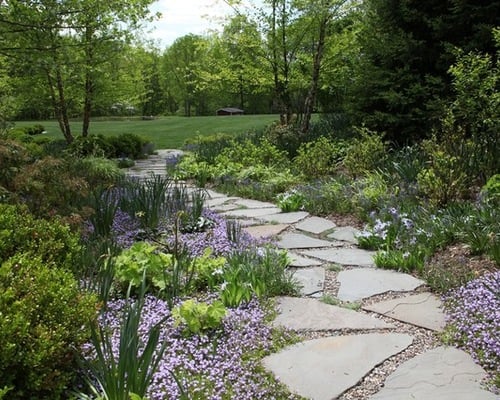
His first job — hauling stone on Martha’s Vineyard — was grueling. Yet Gray, then 24, found he loved the physicality, the dirt-under-the-fingernails honesty of it. He was laid off that winter, called the mason again in spring, and soon found himself in an unlikely position: running a crew on a massive state road project, building miles of stone walls along Route 3 between Concord and Pembroke.
The work was fast and utilitarian, and Gray learned quickly. His aptitude for precision and structure translated well to stone, and before long he was handling residential projects, studying European-style walls, patios and detailed masonry. Landscape architects began requesting him by name. A partnership followed, then — after it proved financially unsustainable — Gray struck out on his own.
By the late 1980s, his stone business was thriving. But a turning point came years later, in 1995, during a winter slowdown, when a landscape architect he admired invited him to Salt Lake City. Homesick for his family back east, Gray was on the verge of leaving when, almost on a whim, he picked up a scrap of limestone and began carving.
“I threw myself into it,” he recalls. Armed with chisels, a diamond grinder and polishing pads he carved by day and studied Rodin and Michelangelo at night. The result — a primitive stone face — was less important than the experience itself. “It took my mind off my worries,” he says. “It was peaceful. My hands felt like they were channeling something.”

A carved head alluding to Gray’s Native American ancestry is perched above a two-sided self-portrait in stone—the polished side represents Gray the artist, while the hand-chiseled, rough side represents Gray the stonemason.
Back in New Hampshire, sculpture became a refuge. During a difficult divorce, Gray carved constantly, despite warnings that he was jeopardizing a successful business. He made pieces for friends and family, then took on small commissions. When Art and Cathy Coviello, who have a summer home in Wolfeboro, commissioned sculptures for each of their numerous grandchildren, one piece led to another. “That’s when I realized I could actually call myself a sculptor,” he says.
Public recognition followed. At the Boston Flower Show, Gray debuted a monumental garden installation — stonework, sculpture, birds in motion — on a rotating platform. Organizers paid him to open the show. He sold nearly every piece, year after year. Sculpture soon became the heart of his practice.
Today, Gray’s work ranges from whale benches and soaring ravens to his signature eagle benches — 60 to 70 of them, carved from massive single stones and often sited along the coast. His largest piece, an 18.5-foot, hand-carved eagle at Alnoba in Kensington, NH, is believed to be the largest of its kind in North America.
Since first meeting Alnoba’s founder, Alan Lewis, in 2019, Gray has been devoted to the organization, placing 16 of his sculptures there and leading art tours on the 600-acre property several times a year.
Despite his success, Gray remains deeply rooted. He still carves at his parents’ property, now a sculpture garden filled with stone paths, spiritual symbols and deeply personal works. He donates generously, carving small marble owls to benefit food banks and conservation causes. “If you do good and you’re kind, it comes back to you,” he says. “Every time I give a piece away, the return is tenfold in some form or another.”
Gray continues to do select stone masonry projects, but sculpture is now his passion and primary focus. “Stone knows when you mean it,” he says. “If you’re open, if you respect it, it gives something back.”
He smiles: “Until I picked up a hammer and chisel in Salt Lake City, when I was almost 40, people told me I wasn’t artistic.” He proved them wrong. “Everything needs passion,” he says. “Especially this.”
Learn more about Joseph Gray’s stone sculpture at josephgraysculpture.com.
For information about Joseph Gray’s Art Tours at Alnoba, go to alnoba.org/event/original-art-tours-2026/2026-10-02/.