Cottage Life with a Postmodern Flair
Timberpeg’s Jim Driesch reflects on more than 50 years of custom post-and-beam builds.

Jim Driesch at a recently completed project.
JIM DRIESCH has an important message for homeowners: Beware of square footage. Chief designer at Claremont-based WHS Homes, Inc., the company that owns and operates Timberpeg, Real Log Homes, Davis Frame Co., Ameri-can Post & Beam, and Jamaica Cottage Shop, Driesch has coached homeowners through designing their dream homes for over 50 years. He sat down with New Hampshire Home to discuss his Nordic roots, postmodernism and the perils of square footage.
How did you get your start in architecture?
I went to school for architecture. When I was a senior in college, we had a semester-long design project, which we had to submit to a committee of architects. I won the competition, and one of the architects hired me. I worked for that architect for three years. We hit a low in the building business, and I ended up skiing for the winter. In the spring, I was hired by Vermont Log Buildings (now Real Log Homes) in Hartland. In the mid-1970s, the company launched Timberpeg, and I helped develop it.

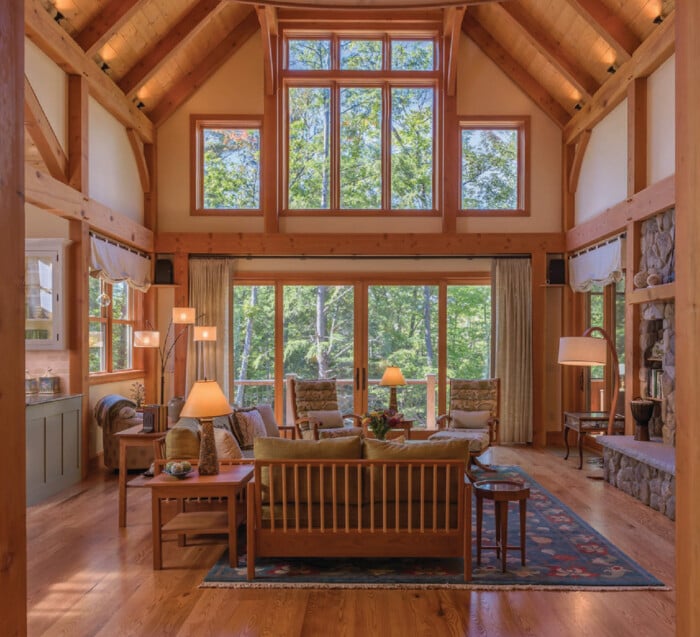
Inside this South Sutton residence, a warm Douglas fir timber frame creates an elegant rustic quality.
What made you fall in love with it?
My great-grandfather was an architect who specialized in church design. He grew up in Norway and apprenticed as a builder and architect at the same time. My father was a carpenter and cabinet-maker, and I worked with him when I was in high school and college. That gave me a background in construction, so when I went to school for architecture, I already knew a lot about construction.
How do those different aspects of your work excite you?
Whether in carpentry, construction or design, every project is different than the last. Every site is different. Every customer is different. You’re trying to create some-thing that the customer wants along with other parameters, such as site conditions, restrictions and code compliances to make that all work together.
You’ve been with Timberpeg for over 50 years. Is there a house that most stands out to you as you reflect upon your work?
One that I like was a house we did a num-ber of years ago called the Lakewood. It was a great collaboration between Old Hampshire Designs and Timberpeg, de-signed for a single woman whose family liked to come visit her at Lake Sunapee. It had to be a cottage, because it was only used in the summer, and we had to fit it to a lot that had a teardown cottage on it. It’s actually a relatively small house — about 2,400 square feet.
Who are some of your artistic influences?
I was in college in the late ‘60s and early ‘70s. One of my professors was a personal friend of Charles Moore, a well-known architect who specialized in postmodern architecture. I always liked that style. To-day, we’re seeing a trend toward midcen-tury modern with box-style architecture, mono-pitched roofs and large panels of glass. In the postmodern era, people were trying to bring back more traditional and older styles, and I really liked that.

A staircase leading to the second floor incorporates wrought iron twig balusters into the design.
What’s the biggest mistake you see homeowners make?
I’ve had a saying for years — “beware of square footage.” Often, people think they have to have a lot of square footage to dis-play what they have. A lot of times, that is the end of a project, because square foot-age equals dollars and most people have a budget. They work themselves right out of affordability. It’s a tough road to go down. Once you’ve made it bigger, it’s very hard to make it smaller.
What advice do you have for people building a home?
I always interview customers and try to find out what they need and want to develop a program around. Most clients are looking for an open kitchen, living and dining spaces. I meet with many clients in the second-home market who purchase lakefront or mountainside properties. They often envision a grand house that everybody comes to visit. In these cases, rather than increasing the square footage by adding more bedrooms, I will often suggest they consider multi-purpose spaces.
It may not make sense to build five bedrooms when you know that not every one of those bedrooms is going to be occupied — only one or two of them at a time might be. Ask yourself, “Do I need a family rec room for when everybody’s there?” If they’re only there for a couple of days, then we probably don’t need to build an entire room for those infrequent occasions.
Where would you rather retire, the lake or the mountains?
The lakes and water have more draw for us over mountains. We bought land in 2017 on Little Sebago Lake in Gray, Maine. We built a small cottage that can be used year-round. NHH