Painting with Plants
For Laura Trowbridge, fine art and gardening go hand in hand.

When Laura Trowbridge moved to Peterborough in 1997, she was the mother of four young children. What little time she could devote to gardening was spent in her large vegetable patch. “My mother had always grown and canned much of our food, and I wanted to do the same for my family,” she says. As time allowed, she began a flower border along a stone wall behind the house. “I got plants from friends and family and just threw them in there in a single row. I didn’t know what I was doing,” she says with a laugh.

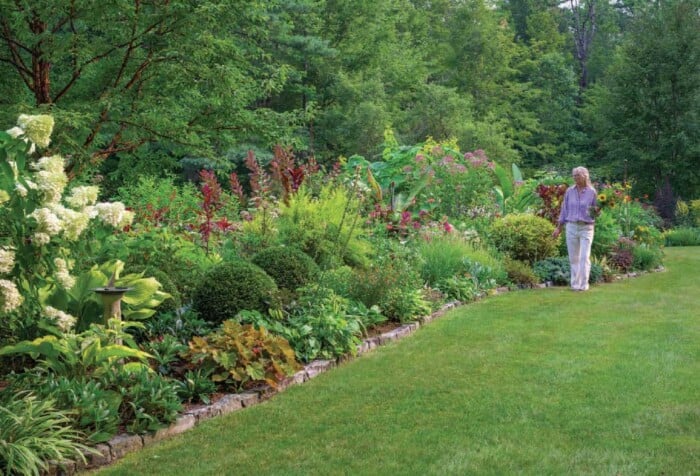
Homeowner, garden designer and budding painter Laura Trowbridge has plenty of flowers to choose from when creating a bouquet. The artistic mix of contrasting colors, shapes, sizes and textures makes the 125-foot-long border behind her house a visual delight all season long.
Eventually, she was drawn to the beautifully designed public gardens planted and maintained around town by a dedicated group of volunteers. “It was so interesting!” she says. “There were so many plants I had never seen before, all with their Latin name tags; I had to find out more about it.” After meeting the volunteer gardeners and their leader, Michael Gordon, she eagerly joined in. “I worked with them for 15 years and soaked up everything I could,” she says. As her children grew, so did her interest in garden design. Soon she began creating gardens not only for herself but for others, and in 2014 she started her own landscape design company: Laura Trowbridge Garden Design.
A Living Canvas
Trowbridge’s garden style has evolved over the years. She made her flower borders much deeper, adding trees and shrubs to the mix of annuals and perennials. The main border is now 125 feet long and 10 to 25 feet deep. “I learned about potted plants to use on my patio and also to echo some of the same plants in the border and window boxes,” she points out. “I like to have all the different gardens talking to each other.”

Trowbridge checks out visiting birds while Luigi relaxes in the shade. From this viewpoint, we can appreciate the repetition and flow of color throughout the border.
Annuals and tropicals are an important part of the landscape, allowing her to change the look of the gardens each year. “It feeds my need for change, and I love giant leaves, color and drama. I like the exuberance,” she says. Having recently taken up painting, she says that, the more she does watercolor, the more she realizes that painting is exactly what she does in her garden, only with plants.
The Kindest Cut
Trees and shrubs are an essential part of many gardens, adding structure and year-round interest, but as they mature they can take up too much space and overwhelm neighboring plants. “It’s a mistake many gardeners make,” says Trowbridge. “We fail to realize how big these plants get.” Eventually, the offending plant may have to be dug up and moved or even cut down. “I’m constantly reevaluating the size of these plants to keep them in balance with the rest of the border,” she says.

Plantings near the old Cape-style house are quietly appropriate from the road, not even hinting at the explosion of color behind the house.
Coppicing is one method Trowbridge employs to keep the plants in her own garden in check. “Coppicing is an age-old pruning technique in which a tree or shrub is cut to the ground or almost to the ground,” she explains. “This severe pruning stimulates the root system to produce abundant new growth, which is often larger and more colorful, but blossoms will be sacrificed.”
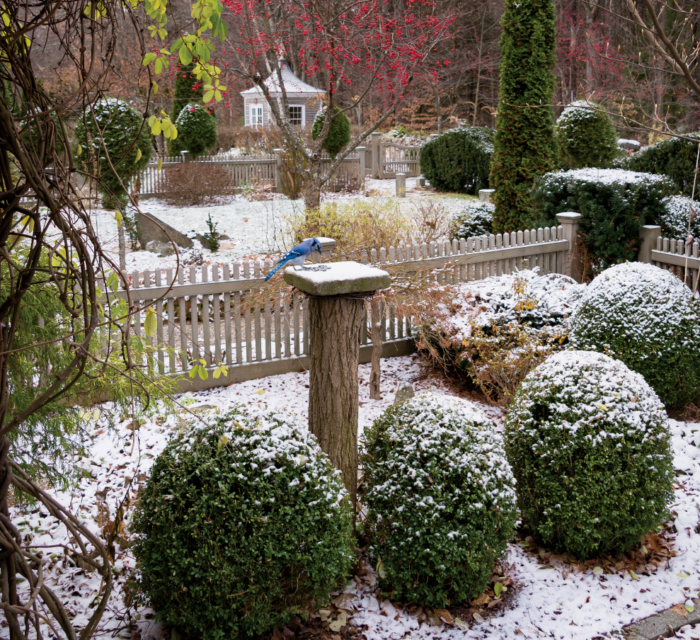
She regularly cuts back her smoke bushes to one foot tall in the spring. “I like the color and size of the new leaves; I don’t need the smoke,” she says. The eleven boxwood balls in the landscape also get a haircut every July to keep them around 2.5 feet tall and wide. Her variegated Chinese elm (Ulmus parviflora) ‘Frosty’ is a slow-growing tree, but it still could become eight feet tall and block her kitchen window if she didn’t keep it pruned. “It gets a major haircut three times a year, like a bonsai,” she says. The princess tree (Pawlonia tomentosa) in her border grows so fast each year she calls it the “Jack and the Beanstalk” plant! “It is root hardy but not stem hardy in our zone, so it dies back to the ground every winter. In the spring, up come the new stems with their huge leaves, and it can grow 14 feet tall and 10 feet wide in a season. Around the Fourth of July, I have to cut it back again to keep it in proportion with the rest of the border,” she explains.

Red canna ‘Australia’ revs up the color after pink ‘Fairy’ rose on the rock in front has gone by.
Another fast-grower in need of attention is the ‘Sunburst’ honey locust (Gleditsia triacanthos). “I planted it in the border early on not realizing it could someday be 40 feet tall and 20 feet wide!” When it eventually blocked her view of the distant hills, it had to go. She cut it to a two-foot- tall stump and the next year it sprouted like a shrub. “Now every spring I treat it like a shrub and cut back the new branches to control its size,” she says. “Sometimes it also needs a second haircut.”
One of the many things Trowbridge has learned over the years is that careful editing is an important part of keeping a design fresh when renovating a mature garden. From her kitchen window, she can see the whole border at once. She says, “To create a pleasing picture, everything has to be in proportion—the colors, density of the foliage and heights of the plants—just like in a painting.”
RESOURCES
Laura Trowbridge Garden Design
603-562-5213
lauratrowbridge.com
Bunker Farm
802-387-0223
thebunkerfarm.com
Edgewater Farm
603-298-5764
edgewaterfarm.com
Inspired Gardener
603-399-4354
inspiredgardener.com