Winter at Juniper Hill Farm
Winter in New Hampshire can be long, covering our gardens with a blanket of snow from November to April, but a well-designed garden can be enjoyed year-round.

Covered with a dusting of snow, the varied plantings in the different garden rooms at Juniper Hill Farm offer plenty of winter interest and draw in all manner of birds and wildlife.
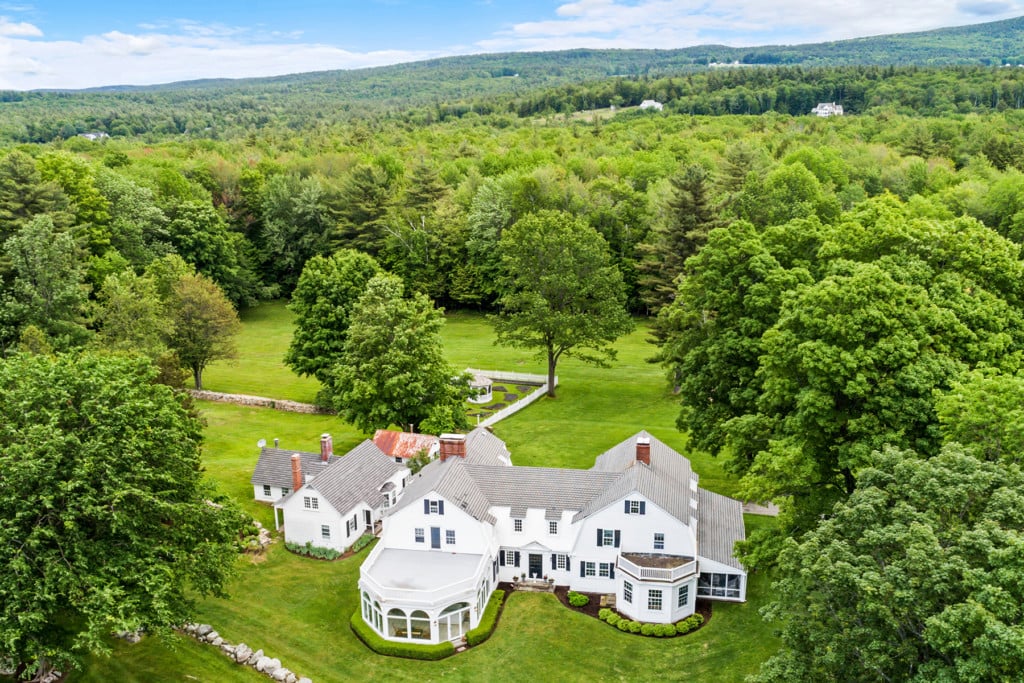
Paula Hunter and Joe Valentine fell in love with their circa 1789 farmstead in Francestown, even though — other than some mature rhododendrons and ancient lilacs — it had minimal land-scaping. After settling in, they began working on the gardens and what was once a large, featureless lawn now has been divided into 12 separate rooms, each with its own personality. Over the past 20-plus years, what started out as a few raised beds near the kitchen door has expanded to cover more than two acres surrounding the house. “I have always believed that the garden should feel like it’s a part of the house,” says Valentine. “When you head outdoors, no matter what door you use, you are immediately in it.”

The woodland temple is a restful destination in any season, providing shade in the summer and shelter from the wind in winter.
Structure
Inspired by garden designer Gordon Hay-ward, Hunter and Valentine spent a lot of time establishing important lines in the garden, building hardscape, and installing fences and hedges before they brought in any plants. “You wouldn’t go out and buy a bunch of furniture and artwork before the walls of your house went up,” says Valentine. “So why would you do the same thing in your garden?” Structure gave a sense of permanence to their gardens while adding depth and dimension to a relatively flat expanse. It also gave them more to enjoy in the winter landscape.

Ornamental grasses, including this Miscanthus sinensis ‘Morning Light’, are left standing all winter so birds can enjoy their seeds.
Rather than turning their backs on the garden and hunkering down indoors when summer ends, Hunter and Valentine embrace what each season has to offer. They have found that all the attention to structure really pays off when the garden is covered with snow, plus it is easier to assess the landscape when it is stripped down to its framework. “Winter is a good time to take stock of what may be outgrowing its spot or in need of significant pruning come spring,” says Hunter.
Hardscape
Hardscaping creates a long-lasting impression in the garden using man-made features such as fences, arbors, walls and outbuildings, and their effect is immediate— no waiting for a tree or hedge to grow. Valentine and Hunter enjoyed visiting famous — and not so famous — gardens in their travels and returned home with some excellent ideas of things to incorporate into their landscape. Juniper Hill Farm now boasts a pool house, whose curved roof was inspired by a garden pavilion at Hidcote Manor and a woodland temple modeled after the Woodland Temple at Highgrove House—both in Gloucestershire, England. He also built an 8-foot-tall by 16-foot-wide see-through wall — like a multipaned window minus the glass — used as a garden room divider. Inspired by a similar one seen during a Rhode Island garden tour, Valentine calls it the “Great Wall.”

The path from the back door to the blue gate beckons you to walk through several garden rooms before revealing the open fields beyond.
Picket and split rail fences are used to delineate spaces and direct the flow of foot traffic. Gates and arbors mark the transition from one garden room to another. Paths may disappear under the snow but tall posts, plinths and pedestals rise above it. “We have an abundance of stone and granite,” says Valentine. “Even the wooden posts are topped with bluestone caps.” A life-sized statue they call Miss Hospitality is strategically placed as a focal point at the end of a long view, to draw your attention. Bird baths stay out all winter, getting fresh water daily and feeders are kept stocked. Without the distraction of flowers and foliage, hardscaping shines.
Softscaping
The couple filled their gardens with plants known not only for their cold-hardiness but also for their structural qualities, winter interest and how they would stand up to snow and ice. Viewing the garden with a photographer’s eye, Valentine finds that after the leaves have fallen, the silhouettes of bare trees cast interesting shadows on the snow. Many trees, including stewartia, paperbark maple and river birch, display textural or exfoliating bark that adds to the drama. Seen from the house, there are multiple layers of hedges with different textures and different heights intersecting with the main path. Deciduous hedges of hornbeam, lilac and privet are as effective as the evergreen hedges at marking boundaries between garden rooms. Like living sculptures, sheared and clipped evergreens such as boxwood, yew, arborvitae and chamaecyparis offer different shapes, colors and sizes.

The symmetrical design around the central urn becomes prominent when the plants are covered with snow.
Wildlife Interest
Crabapples, hollies and native winterberries provide red fruits that last until the birds devour them. “We built the garden not just for humans but for the wildlife around us too,” says Valentine. The gardens have evolved to be more wild farther from the house, and some perennials like coneflower and actaea, along with the ornamental grasses, are left standing to rustle in the winter wind and supply seeds and shelter for birds. “Even with snow on the ground there is winter interest and plenty of birds to see as they pop in and out of the hedges,” says Hunter.
Like clockwork, their corgi, Christina, reminds them each afternoon that it is time for a lap around the garden. “Our snow shoes pack down a path for her short legs,” says Hunter. “And on moonlit nights, a bracing walk around the garden can be invigorating!”
RESOURCES
Peterborough Marble & Granite Works
603-924-3114
pmgw1849.com
Bunker Farm
802-387-0223
thebunkerfarm.com