Design That Restores
Architect and sustainability leader Tracy Kozak discusses climate-smart building, right-sizing our homes, and creating places that nourish both people and planet.

PHOTO BY DEVON LABRIE, LABRIE MEDIA
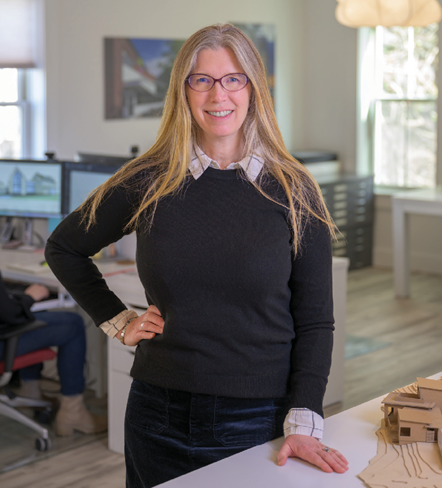
Smart design can enhance daily life, creating spaces that help restore both well-being and spirit. This imperative inspires Tracy Kozak, a leader of sustainable architecture and design in New Hampshire. Kozak founded ARCove Architects in Portsmouth and chairs the New Hampshire American Institute of Architects (AIA) Committee on the Environment.

Tracy Kozak is in the vanguard of New Hampshire architects practicing and promoting sustainable building. Her small-footprint, yellow-painted former family home is in a South End Portsmouth neighborhood. PHOTOS BY JOHN W. HESSION
Taking time out from her work in high-performance sustainability initiatives and historic preservation, she sat down with New Hampshire Home to talk about climate-smart building, decluttering and getting back in touch with our roots.
What is your earliest design memory?
I’ve always designed and made stuff. My dad had a workshop in the basement with tools he had inherited from his father. When I was six, he built a little house in our basement for my brother and me. We did blueprints, bought the lumber, and that was my first build.
Do you have any architects you turn to for inspiration?
I am inspired by the way light interacts with our built environment and how buildings relate to their setting. Louis I. Kahn has always been a favorite—he did the library at Phillips Exeter. His work is very sculptural. It has a great sense of scale, and the way he utilizes shadow and light is very dramatic.
What lights you up about sustainable design?
I’m an outdoor person. The other thing I love, maybe even more than architecture, is riding horses. Before I wanted to be an architect, I wanted to be a jockey. I spend all my free time out on the trails. I have found a profound nourishment of the body and spirit by being outside. Our buildings have to maintain that opportunity for everyone to be able to replenish our spirit and our health. The statistics are shocking. Forty percent of global emissions are from the construction of buildings, so there’s that head-on collision between the two things I love the most. Of course, I have to find a way to make them play well together.
How do you practice that?

ARCove’s design focus for The Commodore residences in Portsmouth was to restore the historical exteriors of the 1810 building while enhancing the interiors of 21 apartments with contemporary finishes and fixtures.
We do energy modeling and embodied carbon analysis of every project from the very beginning of the concept design. We strive to hit performance targets. Code minimum is generally not what we’re going for. We’re looking for high-performance buildings in a way that makes sense to the program and budget of each project. By doing these extra steps at the beginning, we’re able to add value by improving performance over the building’s lifetime.
I’m also chair of the AIA Committee on the Environment in New Hampshire. Our primary objective is to provide education for other designers and people related to the building and construction trades, so that we have the tools to do these designs that work best for sustainability.
You’re leading a case study on the lifetime cost of operating a single-family home. What have you found so far?
New Hampshire is lagging behind. The current energy code is 2024, and New Hampshire keeps holding at 2018. There’s a fear that it will increase construction costs, specifically with single-family housing. Anybody who does energy modeling or operates a building over time knows that choices in how we build affect the overall cost, so we thought maybe not everybody has all the information. We did a study on a multifamily home last year, which was a collaboration of several people — engineers, folks from Dartmouth, scientists and financial analysts—and it showed negligible first cost within two years. We found similar results of an analysis on a single-family house based on an ARCove design.
What advice do you have for people who want to build their home sustainably

ARCove restored the 1818 Treadwell Mansion in Portsmouth, the home of Ann Stocker Pearse Treadwell, a wealthy merchant’s widow.
First, durability of the materials. Cheap materials that don’t last ultimately cost more. They break, fail, leak and rot, then you’ll have to do it again. The other thing I love to have people consider is efficiency of space. There has been an overwhelming trend toward large living spaces and accumulation of stuff. I raised a family of four for 27 years in a house that was 862 square feet. It was challenging at times, not because people take up space, but stuff takes up space. Driving through the countryside, even in rural New Hampshire, there’s lots of self-storage buildings in a land where the houses are already big. We can shrink spaces to what we need and use spaces for multiple purposes at different times of day: convertible furniture, convertible spaces, walls that move. If we could shrink the average size in American homes by 10%, that’s a huge global impact on overall carbon emissions and global warming.
What’s New Hampshire’s best-kept secret?
The history. We learn where we want to go by knowing where we have been. It’s like a treasure hunt when we do a historical assessment. We dig into the people that lived there, the events that happened, the crafters that created it, and there are always fascinating stories. People are inherently interesting, and most of this history is hidden. It is in letters in people’s attics. It’s in file drawers in dusty old museums. They’re not online. They’re not talked about. History is, I think, falling out of fashion with the fast-paced world of media. It’s such a rich resource to pull from. It’s our heritage, and it helps ground communities and connect people, which is the strength of our universe.