Sense of Place
Architect Katie Sutherland draws on Japanese design principles, historic preservation and a deep respect for the natural world to shape homes that are as sustainable as they are serene.

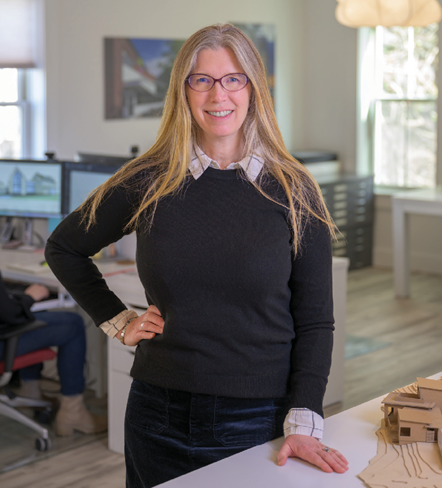
PHOTO BY JOHN W. HESSION
For Katie Sutherland, founder and principal architect at Marlborough’s kcs ARCHITECTS, a sense of place is everything. Her childhood in Lexington, Kentucky, fostered a profound commitment to historic preservation. While in architecture school at Yale, a student fellowship with the Takenaka Corporation in Osaka exposed her to new ways of thinking about integrating nature in our built environments.
Committed to sustainable architecture, Sutherland was recognized by New Hampshire Home for Best Net Zero House and Best Small House at this year’s Design Awards ceremony. She sat down with us to discuss outdoor spaces, influences from Japan and a surprising history of the painter Henry Faulkner.
What is your earliest design memory?
I’ve always loved the work of Frida Kahlo and her whole approach to life, activism and art. Growing up in Lexington, Kentucky, we lived across the street from the artist Henry Faulkner. He was a painter and used to go to Key West in the summer and hang out with Tennessee Williams and Ernest Hemingway. He did these wonderful, fantastical paintings, a lot of them of buildings, but a lot of them of his goats. He had all these goats and other animals that he kept in his historic house and dressed them up in heels and pearls. He was such a dream as a child.
There was an opportunity I had probably 12 years ago to renovate his house in Lexington for the then owners, who had also been connected to Henry. It was a wonderful opportunity to come full circle and revisit that place.

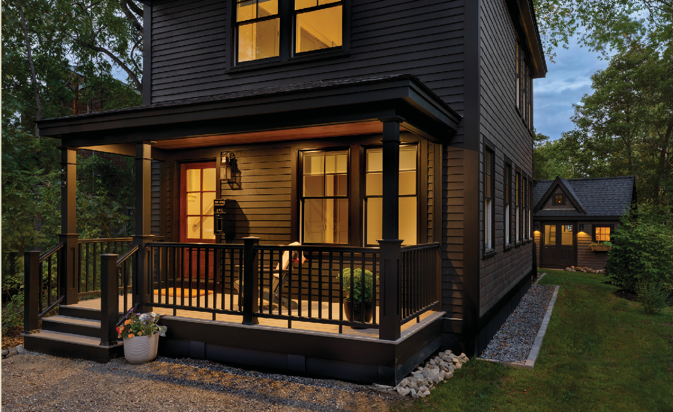
The Loft ADU is a modern accessory dwelling unit defined by clean forms, natural light, enduring materials and energy production. PHOTO BY RYAN BENT
There are also several architects I admire. Kazuyo Sejima and Toshiko Mori are female Japanese architects I like a lot. I worked and lived in Japan, so that has a big influence on my work— the way that traditional buildings, homes or temples connect to the natural world. The word “engawa” refers to the space in a house between outside and inside. A lot of traditional Japanese homes circulate around the outside with layers of enclosure and opening to the outside world.
Moving outside of Japan, there’s Peter Zumthor in Switzerland, who came to architecture from a background in carpentry and has an amazing sense of materiality and place.
Are engawa, materiality and place key inspirations in your work?
If we’re working on a cultural building or a single-family home, we’re thinking about where that building is: the place, how it is oriented on-site to best take advantage of the sun, natural ventilation, any views and the materials of the site. We always consider it a collaboration with our clients to make the building right for them and size the building for their needs. That’s an important design criterion for us: how the building responds to the place in a sustainable and artistic way.
You were just honored by New Hampshire Home for Best Net Zero House and Best Small House. What motivates you with that work?

A contemporary addition to an antique farmhouse reconnects the house to its site through expansive glazing and a seamless indoor–outdoor flow. PHOTO BY RYAN BENT
In space as well as aesthetics, I tend to be sparing on some level. I want it to be pure and elegant without being overdone or ostentatious. It’s important that all of the work we do is environmentally responsible and sustainable. Construction has the biggest carbon footprint on the planet. We have to be mindful of that and either find ways to reuse the building stock that we have in a creative way or be mindful of not creating more space.
What advice do you have for homeowners?
You’d be surprised how many times clients come in with a wish list that is bigger than their needs list. We do our best to help rationalize a client’s wish list within a reasonable budget. Cost of construction has increased since COVID. We have to be careful with estimating upfront and setting expectations to keep the project going and realistic.
Can you give us insights on your initial approach to a project?
Looking at a site — even if it’s an existing building or a gut renovation — and taking advantage of things like wind, sun and what part of the site are going to be outdoor versus indoor space. The other thing that I think all of us as architects learn over time is being able to trouble-shoot building systems and bringing in the mechanical systems in a way that’s harmonious to the design.
What do you love about working in New Hampshire?
I love the tree bathing. I grew up in Lexington, which is a city of about 300,000, and went to college in New York City. I worked there about 10 years before I was convinced to move to New Hampshire. My favorite thing about the state is being able to appreciate the outdoors in a different way than I could growing up or in my young adulthood. So many of the building sites have more connections to the outside or to public circulation, pedestrian pathways or woods. There’s a lot more inspiration to connect to those outdoor places with your building designs.