Listening to the Land
Inspired by the contours of the countryside, a master gardener cultivates richly layered gardens.

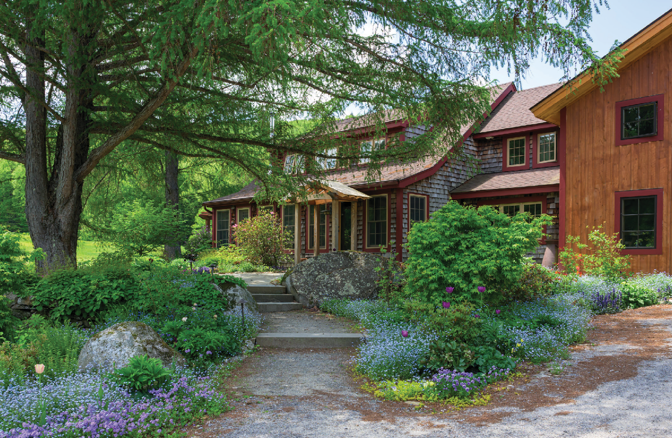
In spring, blue-flowering plants including phlox, forget-me-nots and pansies flank the path to the front door. Shrubby Korean maple on the right often has Baltimore orioles nesting in it.

As spring-blooming plants fade, hostas will open up and fill in the space left behind.
At the end of a long dirt road in Cheshire County, a farmhouse dating back to the 1790s sits on a knoll overlooking rolling meadows and nearby hills. Inspired by the soft curves of the land, the homeowner, already a vegetable gardener, got interested in flowers as a way to develop a connection between the house and outdoors. “The heather garden was the first one I built,” she says. Influenced by the book “Right Plant, Right Place,” she thought heathers would fit perfectly in the sandy soil and southeast facing aspect. Many years later, the heather blossoms still greet her first thing in spring. “My biggest delight is seeing them even before the daffodils bloom,” she says.
Volunteers Are Welcomed
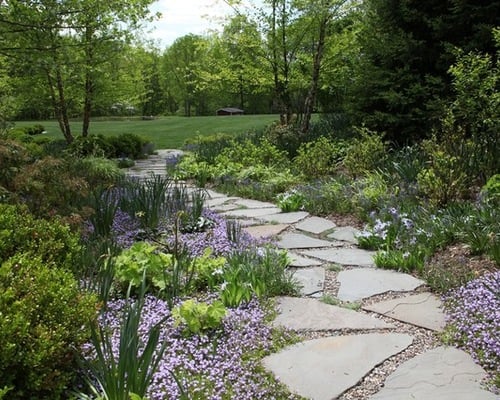
Over the past 30-plus years she has created numerous multi-layered gardens —including rock gardens, berm gardens, a meadow garden, kitchen garden, entry garden and shade garden — that flow from one to the next. “I love design of all kinds, and plants have been a wonderful material to work with,” she says. The beds are all curved and planted in drifts rather than rows, imparting a more natural look, and she embraces self-sowing plants that show up unexpectedly. “Angelica pops up here and there and a volunteer Joe Pye weed put itself in the perfect place so we can see it from the back door,” she says. “When a plant finds its own spot, it’s usually a good one!” For continuity, she takes a few things from each bed and repeats them in others, to tie it all together.

A water-filled stone bowl surrounded by bleeding hearts, ‘Catlin’s Giant’ ajuga, epimedium and brunnera ‘Jack Frost’ attracts birds, frogs and other small wildlife.
Color Beyond Blooms
Textures and unusual colors abound here. “I love what you can do just with foliage,” she says. Chartreuse, gray and purple are favorite colors. Black mondo grass paired with chartreuse ‘Angelina’ sedum or silver-green lamb’s ears with purple sedums are just a couple of striking combinations. Coreopsis ‘Nana’ stays low, often reblooms, and is a staple here. “Yellow moneywort knits things together,” she says. “I know it’s considered aggressive, but I adore it and am willing to rip it out if needed.” Other favorites are ‘Obsidian’ and ‘Bronze Wave’ heucheras, dusky cranesbill (Geranium phaeum) with its dark purple spots, gray-leaved pussytoes, tiarella, maidenhair ferns and yellow thyme. There is not a lot of space between plants. “I love overflowing, informal gardens,” she says.
Trees and Shrubs
“The Korean maples in the front garden have wonderful color spring and fall, warm shades of orange, red, yellow and even a bit of purple. In the summer they are green,” she says. “What I also love about them is their smallish size — 15 to 25 feet tall and wide — and their hardiness.” Favorite shrubs include glossy-leaved paxistima, arborvitae ‘Fire Chief’, purple smokebush, dark-leaved ‘Diablo’ ninebark and spirea ‘Ogon,’ whose golden spring leaves become orange in fall. “I also love using stems from shrubs in flower arrangements,” she says. Upright ‘Gold Cone’ junipers are super hardy, and at 5 to 6 feet tall, make a good punctuation mark, adding the only formal element to the garden.

An open-topped skyframe pergola covers the terrace and deck, then steps down a few feet to cover the stone-walled tiers of the kitchen garden.
Making Connections
A talented Master Gardener who has yet to run out of ideas, she is still striving to better connect the house with the landscape. One method was to erect an open-topped pergola called a skyframe over the terrace that steps down a level as the land slopes away. This eases the transition from the house to the lower gardens without blocking the sun. “The land is my muse,” she says. “I am working to mimic more of the meadow, while pushing the gardens out into it.” Currently, grasses including prairie dropseed and a big bluestem cultivar called ‘Blackhawks’ are of particular interest. “I also love purple lovegrass,” she says. “It pairs well with ‘Apricotta’ cosmos and is the highlight of fall here.” At the rear of the house, a mixed perennial border along a rustic fence of locust branches marks the transition from tended garden areas to the meadow. Though she mows a few paths through the grass, the field as a whole is not cut until late fall after the birds are gone.
Future Projects
When a super storm took out the dam that had formed a lovely pond next to the summerhouse, our homeowner became determined to return water features to the property. Works in progress include a grotto with stone fountain, a dipping pool, a lotus bog and a rain garden.
Take a Tour
Last summer marked the third time our homeowner has opened up her garden to visitors during the Garden Conservancy Open Days program. “I’m a big garden tour attendee myself and have been for years. It’s how I learned what I liked and got my start,” she says, “plus it’s a lot of fun connecting with other gardeners, hearing their stories and sharing tips.”
There are many more open gardens in New Hampshire that you can visit in July and August.
Go to gardenconservancy.org/garden-directory/open-days?location=new+hampshire for locations, dates, times and tickets.
RESOURCES
Edgewater Farm
603-298-5764
edgewaterfarm.com
House by the Side of the Road
603-654-9888
housebythesideoftheroad.com
Maple Hill Nursery
603-357-2555
maplehillnursery.com
Walker Farm
802-254-2051
walkerfarm.com