Aligned With Tradition
Exquisite craftsmanship in furniture-making is David Lamb’s calling card.

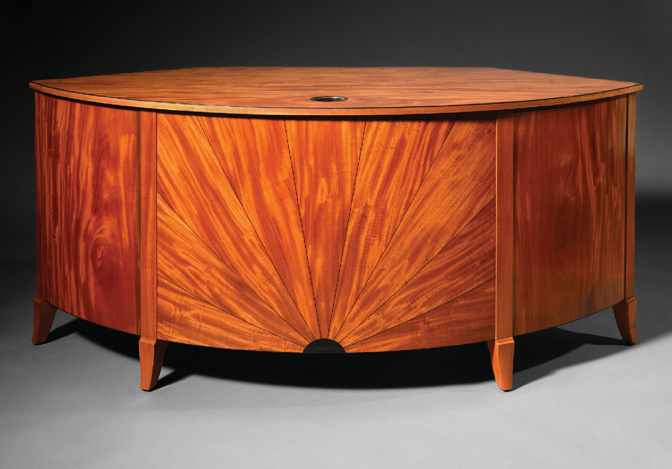
A recently commissioned 6-foot-wide circular office desk in mahogany with ebony line inlay detailing. The central panel features a radial flaming effect.

Lamb installs a maple leaf carved leg cap on a current demi-lune table commission.
Furniture-maker David Lamb enjoys what he calls a nice continuum of space. “It all started right here, over 50 years ago,” says Lamb, referring to his home and workshop in Canterbury. “I really haven’t wandered too far.”
His geographical location may have remained constant — he works in the same building where he apprenticed as a teenager, and he and his wife live in a former teacher’s house — but his craftsmanship and acclaim have reached monumental heights. He has won numerous design awards, is a founding member of the New Hampshire Furniture Masters Association, and served as the state’s Artist Laureate from 2010 to 2014. Lamb’s elegant and classical pieces are on display in homes and galleries across the country, as well as at the Currier Museum of Art in Manchester.
Raised at Canterbury Shaker Village, where his stepfather worked for the Shakers, Lamb apprenticed with the shop master, Alejandro de la Cruz, who emigrated from Madrid with his wife in the early 1950s. “Mr. De la Cruz saw some of the woodworking I had done as a middle schooler, and he asked me if I’d like to come down and learn (the art of furniture-making),” says Lamb. “It was a walk down the hill to learn the trade and the lifestyle. Then, in the other direction, I went to high school, where I met my future wife.”

The back of the circular office desk on page 40. It is designed to be fully functional with allowances for contemporary business needs.
Lamb explains that his mentor gave him classical training in the fundamentals and foundation of good design, exquisite craftsmanship and strong business/client relationships. Formal schooling
in Boston University’s Program in Artisanry followed.
He now designs and builds furniture on commission in that same shop in Canterbury, drawing inspiration from his natural surroundings. “Being in New Hampshire underscores the traditional aspect, because it’s a place where they’ve been doing things the same way for a long time,” says Lamb. “The other part that really inspires me is the bucolic nature of where we live.
“I find that I can blend those two things in a classical format, that folks who see my work are comfortable with because of that sense of familiarity,” he continues, “and at the same time, I introduce new design themes and aspects that are largely driven by natural form.”
One example is a recent demi-lune table for a client. A demi-lune is one half of an elliptical shape, which Lamb notes is classical in nature. “I used birch, which happens to be the state tree, and the other primary material on this table is mahogany,” he says. “I use that partly because it’s customer driven, and also because it’s an elegant material that relates to historical classical form. It plays a number of roles, and helps show off what I’m putting out on top.”

Black ice detailing on a demi-lune table. (PHOTO BY BILL TRUSLOW)
The table’s legs are turned in the Federal style. “They’re feminine and delicate, which marries with the top: a veneered surface with a fractal pattern,” says Lamb. “I interpret things like ice crystals — whether it’s black ice like on a pond or frost on a window — utilizing wood in a feathery kind of figuring. If I dye it black, I call it black ice; if I leave the natural sort of golden color, I call it frost.”
A similar large-scale piece, “The New Hampshire Secretary,” is part of the permanent collection at the Currier. “It is 8 1/2-feet tall and statuesque, yet elegantly simple,” he explains. “It has some nice carvings on it, and the whole thing is covered with this fractal patterning. I consider it a nod to the history and natural beauty of the state.”
Another of Lamb’s passions for history centers on collecting 1880–1910 vintage furniture-making machinery. Ten years after he bought the property where he lives and works, he acquired a 19th-century high-posted timber frame mill building and moved it to his property, attaching it to the original shop building, to serve as “his little museum.”
“There is this particular line of machinery that I’ve been interested in (from the John A. White Company of Concord and Dover),” says Lamb, “I think it is very aesthetically pleasing and historically interesting. It’s kind of a study in form for me, a nod to history, and I enjoy using it.”

Covered with birch fractal veneer work, “The New Hampshire Secretary” is part of the Currier Museum of Art’s permanent collection.
With 95% of his work commissioned and many homeowners purchasing multiple pieces over the years, Lamb has time to explore new concepts in form and craft. “What I find very appealing and exciting is that, when I have an idea, I can propose it to customers and they end up being supportive,” he shares. “This allows me to explore things. It’s been very, very fruitful and a great growing opportunity.”
In addition to his solo work, Lamb has participated in some exciting collaborative projects: “I’ve worked closely with a historical conservator and architect named Mark Adams on some exquisite furniture for high-end clients in New York and southern New England, and I also did four pieces with painter James Aponovich, another former New Hampshire Artist Laureate.”
Happily ensconced in the same world where he grew up, Lamb and his wife, Janet, have eased into a restful and inspirational way of life. She is his primary finisher, with whom he discusses design ideas — “She does the polishing and waxing, the brushing out of the shellac and the steel wooling; all the work that makes everything look so good.” — and the work they do offers multiple versions of fulfillment.
“Making this kind of furniture takes a long time, and I’ve done some very significant pieces that hit a number of different pinnacles; other pieces end up without a lot of extra profit,” he says. “It is the challenge of being an artist or a craftsman. You know you’re doing this work because you love doing it. And it’s not all about the money. It affords the lifestyle I want and that I have always loved.”
For further information about David Lamb, visit davidlambfurniture.com.